

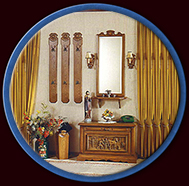
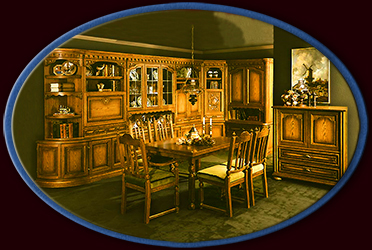
Fine carved furniture – custom pieces (currently not available)
At the moment, new furniture pieces cannot be commissioned.
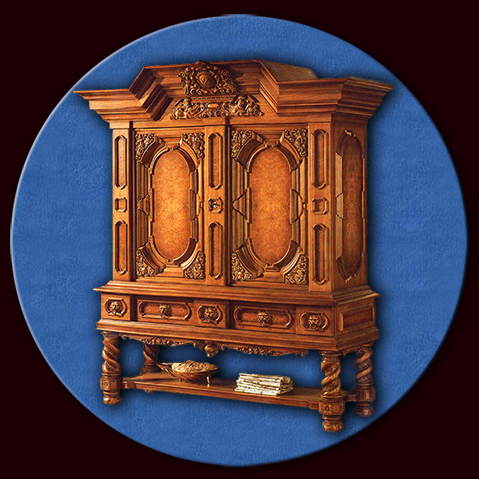 Cabinet
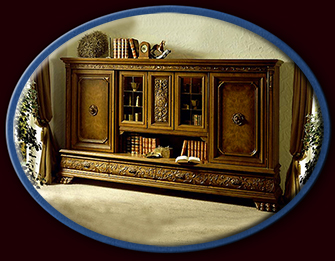
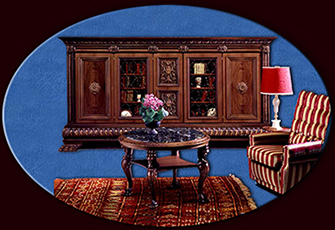
Enquiry by email
Important European ornament styles
Ornamentation has changed a lot over the centuries. Some of the most important European styles are:
Romanesque (approx. 850–1250)
Characteristics: powerful block forms, round arches, interlace bands, simple leaves.
Effect: massive, grounded, archaic.
Gothic (approx. 1230–1500)
Characteristics: pointed arches, tracery, fine tendrils, long leaf tips.
Effect: soaring, perforated, filigree.
Renaissance (approx. 1500–1620)
Characteristics: clear structure, panels, egg-and-dart, beading, acanthus leaves.
Effect: calm, balanced, architecturally ordered.
Baroque (approx. 1600–1730)
Characteristics: strong movement, bold acanthus, S-curves, flowing transitions.
Effect: dramatic, rich, powerful.
Rococo (approx. 1730–1780)
Characteristics: rocaille shells, fine leaf scrolls, asymmetrical curves.
Effect: light, playful, elegant.
Neoclassicism (approx. 1770–1830)
Characteristics: clear axes, garlands, laurel wreaths, antique motifs.
Effect: strict, calm, nobly restrained.
Ornaments in practice and restoration
In restoration or when adding new parts, it is essential to match the original style and proportion. Typical tasks include:
- Adding missing furniture ornaments (corners, panel frames, centre pieces)
- New gable ornaments for half-timbered houses or entrance doors
- Frame ornaments for mirrors and pictures in the correct period style
- Ornaments on sacred pieces (altars, pulpits, home altars)
In my workshop these ornaments are carved by hand as one-of-a-kind pieces – matching the existing style, the wood species and the planned finish (natural, stained, painted or gilded).
Literature and sources on ornament
If you would like to dive deeper into ornament, you will find many ideas in:
- Style books on European furniture and architecture
- Pattern books with ornament plates from Baroque, Rococo and Neoclassicism
- Museums and collections of historical furniture and woodcarving
Concrete information on the creation and pricing of hand-carved ornaments can be found on the page:
- Home
- Coats of arms – overview
- Coat of arms information
- Heraldry glossary
- Family Coats of Arms
- Coat of arms videos
- Coat of arms flip shows
- Ornaments
- Ornament Info
- Ornament Lexicon
- Figures & documentation
- Sacred works
- Front doors
- Half-timbered work
- Period furniture
- my eBay shop
- Privacy policy
- Imprint / legal notice